Tuesday, August 5, 2014

Good People: Kate Hudson Wears The Pants, Perfecting Ballsy Moves Against Bad Guys


Nuclear family noir faces off against gangster thriller gore in Good People. Simultaneously referencing traditional mobster mayhem and bleak, apocalyptic end stage capitalism in a recession stricken world.

James Franco and Kate Hudson are Tom and Anna Reed in Good People, an economically struggling young American couple migrating to London after Anna inherits a dilapidated family home there. Determined to renovate the aged structure in nearly complete shambles while relying on Tom's carpentry skills but few funds, the frustrated  duo are elated when a downstairs neighbor in the building where they live is found murdered, but leaving behind a huge amount of hidden cash they discover there. Money that they attempt to rationalize, has no moral value in and of itself, it's what people do with it that creates ethical quandaries.

And turning up to drive those problematic points home rather quickly as the pair begins to pay off debts, are no less than three warring parties. Counting a deeply suspicious detective (Tom Wilkinson) with his own hidden agenda, local drug dealers from whom the money was originally stolen, and French gangsters who were ripped off by the local thugs in the first place. Leaving the couple in the unfortunate predicament of eluding everyone in question at the same time, in order to save their lives.

Kate Hudson wears the pants in this particular family outing, with Franco frequently deferring to her ballsy moves intercepting the bad guys, more comfortable apparently with applying his craftsman skills to a kind of creative blue collar class warfare. And with the various menacing intruders when not homicidal busybodies standing in somewhat for a metaphorical late capitalism doing battle with itself, and those at the bottom left essentially with no side to choose from or any traditional good versus, evil amid multiple malevolent threats. Whether implicating ruthless greed, official corruption, or perfected torture in the pursuit of ill gotten gain.

Directed by masterfully bold and socially intuitive Danish filmmaker Henrik Ruben Genz (Terribly Happy) and adapted by Kelly Masterson (Snowpiercer, Before The Devil Knows You're Dead) from the  Marcus Sakey novel, Good People anchors this story in a sobering subtext beyond its otherwise conventional thriller roots. Channeling guerrilla imagination with whatever tools at hand, and workingclass resistance in a nearly futile hi-tech weaponry world. Or as a confident Kate Hudson declares at a key moment in confronting formidable, elaborately armed opponents from all sides, "Guns are for pussies."

Monday, August 4, 2014

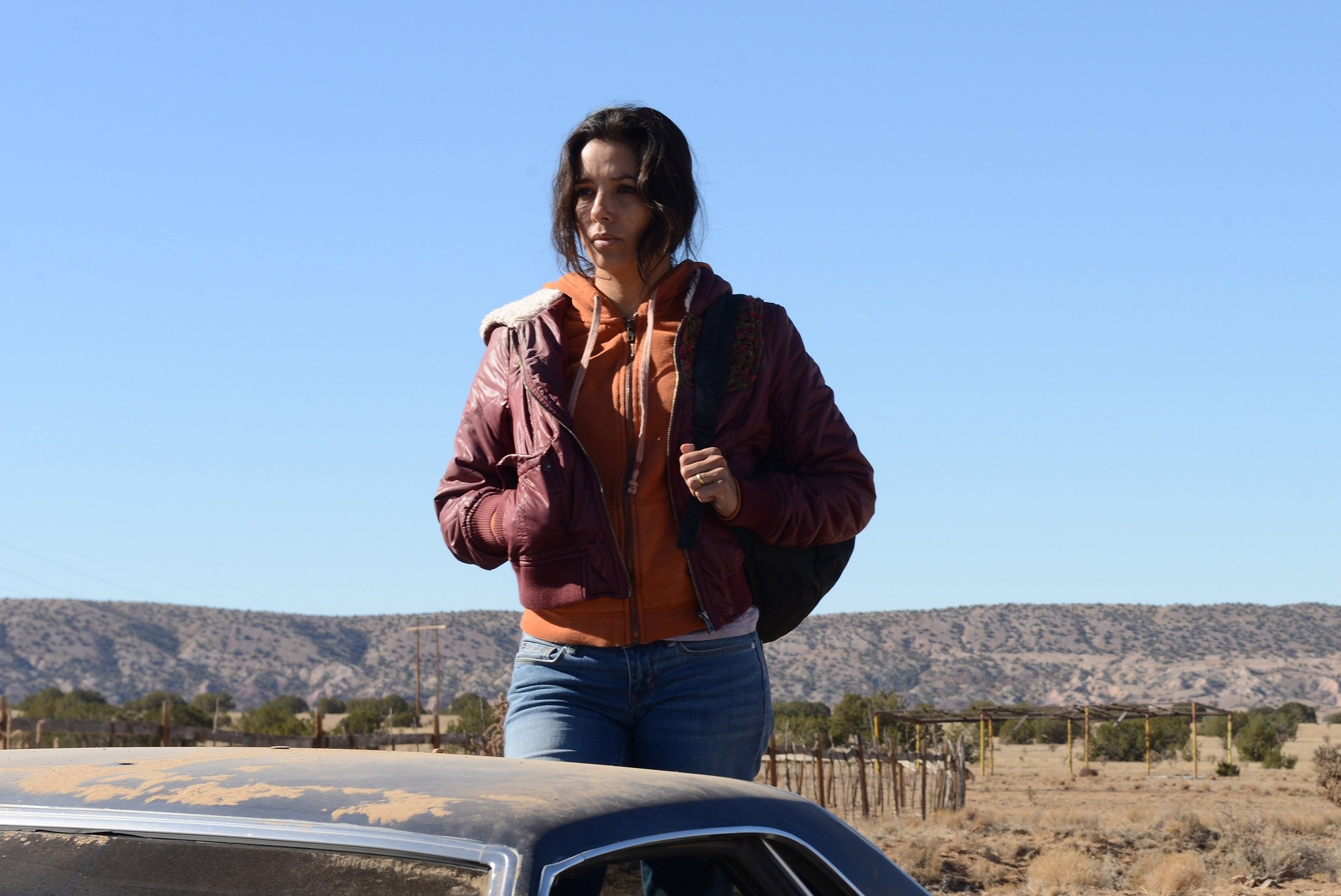
Frontera: Eva Longoria Desperate Housewife In Hell, In Brewing Border Wars Bromance


Actor Michael Pena, who already displayed his tremendous talent and conviction earlier this year filling the formidable shoes as larger than life fearless farm worker activist and UFW labor leader Cesar Chavez in the biopic bearing his name, brings this same fury and idealist commitment to an ordinary man thrust into extraordinary historical circumstances, in Frontera. This brewing border wars bromance initially pits Pena against a disgruntled retired Arizona sheriff played with magnificent complexity and subtlety by Ed Harris, a rancher perpetually peeved about undocumented Mexicans crossing his land in search of work and sustenance in the United States.

In the course of embarking on that journey he's taken many times before to support his family back in Mexico and his now pregnant wife (Eva Longoria), Pena and a companion become trapped as unfortunate victims of apparent rifle target practice by bullying gringo teens cornering them from a cliff. In the course of which Harris' wife (Amy Madigan) who is passing by riding her horse, is caught up in the terrifying moment and suffers a tragic accident.

And in the ensuing panic and rage gripping that small Arizona town, Pena's bewildered migrant is imprisoned and his brave and determined wife travels across the border on a subsequently dangerous mission to find and save him. Even as doubts about what really transpired beyond racist accusations, hidden agendas and coverups trouble the former sheriff. As he takes matters into his own hand to the dismay of the police force, and mounts his own investigation.

Vigilantism, whether spurred on by homicidal revenge or on the other hand idealistic protest opposing official injustice, has long been an enduring theme in American movies, and no surprise there. With a US government that increasingly ranges from corruption to a woefully broken system, frustrated civilian activism whether from the right or left, is spurred on. And Michael Berry's Frontera blends these timely socio-political elements in dramatically bracing ways, intertwined with the current south of the border turbulent immigrant crisis in progress today.

Friday, August 1, 2014

The One I Love: Or Not, In This Split Personality, Identity Theft Small Talk Romance


With a movie title borrowed from the name of The Mamas And Papas classic song, this choice would appear to be not quite random, as the duo in question starring in this split personality sex romp might be termed the Ethans and the Sophies, played by Mark Duplass and Elisabeth Moss respectively. And setting in somewhat circular and repetitive motion, a sci fi relationship scenario laced with guilt free, cake and eat it infidelity.

And if all that sounds as philosophical as theatrical in equal measure, perhaps that was the point as crafted by director Charlie McDowell and first time screenwriter Justin Lader. And seeming as much an idea for a movie as an actual dramatic feature, as well as that problematic divide between the idealized or misremembered fantasy of a lover and who they actually are, not to mention yourself in their potentially disappointed eyes in turn.

Along with how that weighty emotional baggage can precipitate the sort of identity crisis where in eager-to-please mode lavished upon your object of desire, you begin to no longer be in touch with or recognize who your really are. Or in other words, in not sounding like your usual self lately while putting your best foot forward - there is uncertainty if it's even your foot any longer. Enough said about the mysterious meanderings of this crabby when not cosmic, identity theft small talk satirical romance.

The rather perpetual primary plot point of the movie concerns Ethan and Sophie as a borderline estranged married couple entering into relationship therapy, conducted by an unorthodox shrink played by Ted Danson. Hopelessly failing the adviser's compatibility exercises, the pair upon his recommendation head to his specially designed rustic reconciliation retreat. Whereupon they enter perhaps a claustrophobic parallel universe of sorts, having something to do in an exceeding stretch of the imagination with Russian stacking dolls and aardvarks.

The One I Love - or perhaps more aptly The Ones I Love - seems more grounded in concepts and a dash of mystical intrigue than momentum and dramatic pacing. Along with the nagging notion that if you're as bored with this couple as they apparently are with one another, that's not a good sign.

Which raises a question about that tendency these internalized indie characters with their shallow intimacy seem to share. That the cure may not lie within generating even more self-entertaining amusement and wonder, but rather hey, how about getting close by getting in touch with life on the planet, and the teeming world all around you.

Wednesday, July 30, 2014

Around The Block: Christina Ricci Does Hamlet In The Hood

                    Hunter Page-Lochard as Hamlet In The Hood    

...Hamlet In The Hood. Petite Christina Ricci displays a big heart and radiates warmth and resolve, as she gets in touch with her inner maternal instinct - apparently both on and off screen right now. Ricci portrays a high school teacher transplanted from the States to inner city Australia, coaxing the initially less than enthused local Aboriginee teens into a culturally conscious production of the Shakespearean play. And linking the alienation, passion, frustration and despair at the heart of Hamlet to disaffected youth of color today, who knew. First time writer/director Sarah Spillane elicits raw, genuine, organic performances from her young cast, though compromised by an afterschool special conventional story. And tossing into the mix that lesbians turn gay because men have bad personalities, was a gratuitous addition.

Tuesday, July 29, 2014

The Calling: Mysticism, Maniacs And Assassins With Assisted Suicidal Tendencies


The summer season is not exactly shaping up as a showcase for positive images of the priesthood in movies. On the heels of Irish writer/director John Michael McDonagh's comedic crime thriller Cavalry, in which a mystery avenger is obsessed with gunning down a countryside cleric, The Calling sort of flips the sacramental script. As a felonious religious fanatic, possibly in league with a local Catholic Church parish, seeks out victims for homicidal redemption, don't ask.

Susan Sarandon is Detective Hazel Micallef in The Calling, a rural Canadian down in the dumps detective suddenly up against an elusive serial killer stalking the vicinity. And the rising body count is initially not only seemingly random, but gruesome and bizarre as well. With open mouthed corpses that appear to have died while singing, and dogs dining on one victim's severed human stomach in a frozen field.

Meanwhile, afflicted with a bad back and even worse disposition, Hazel is furiously on the case, even as she alleviates whatever ails her with ample infusions of alcohol and drugs - some of the pills surreptitiously swiped from crime scenes. Soon joining Hazel in the investigation to her dismay, is Ben (Topher Grace), a young, overly enthused big city cop sent on assorted wild goose chases around the country, courtesy of mom's frequent flyer mileage.

In any case, what eventually comes to light is exceedingly murky evidence referencing ancient scriptures, Christian mysticism, toxic tea sipping, tattoo cleansing, terminal illness chatrooms, a highly suspect online link at faithforthedying.com, and one odd combo assisted suicide assassin. Or possibly two. Also on hand to toss in their two cents are Ellen Burstyn as Sarandon's nagging resident matriarch, and Donald Sutherland as a reclusive cleric who ponders in Latin.

The Calling is a somber and suspenseful twisted tale with lots of lapsed Catholicism to say the least, not to mention lapses in logic. But a story that is nicely held together owing to vigorous performances and moody atmosphere. The production is also layered with quite of bit of strange elements of its own. Including The Calling's South African filmmaker Jason Stone's previous dabbling in supernatural weirdness as the writer/director of Jay And Seth Versus The Apocalypse starring Seth Rogen and Jay Baruchel, and the screenwriter Scott Abramovitch's prior televangelical comedy, Prayer Hour.

Along with Inger Ash Wolfe, whose novel The Calling was adapted for this film, not being Inger Ash Wolfe at all. But rather Canadian writer Michael Redhill - who only just outed himself as to his real identity in 2012.

Sunday, July 13, 2014

The Young And Prodigious T.S. Spivet: Intellectual Consciousness And Brutal US Capitalist Conformity


While a movie directed by an outsider delving into American life may suffer the pitfalls of idiomatic mishaps lost in translation so to speak, a detached point of view can on the other hand, shine a sharper and less hesitant, self-conscious light on the native foibles and fears at hand. Such was the case last year with British director Steve McQueen's unprecedented, uncompromising scrutiny of that shameful, brutal period of buried US history this country has always been averse to confronting, with his scathing dramatic biopic, 12 Years A Slave.

Not nearly as raw and revealing, but certainly striking a few sensitive nerves with its gently probing satirical bite, is French director Jean-Pierre Jeunet's The Young And Prodigious T.S. Spivet. Bringing his bold and cutting edge wit to this scrutiny of peculiar when not outlandish American customs and bad behavior, Jeunet's mischievously playful cinematic reputation precedes him, with raucous gems like Delicatessen and Amelie.

Derived from Reif Larsen's illustrated debut novel, The Selected Works of TS Spivet, Jeunet's adaptation is deceptively crafted as a child's adventure. But within that visually stunning,  imaginative tale is an excursion through the darker heart and paradoxically damaged soul of America.

Kyle Catlett is the T.S. Spivet in question, a beyond precocious ten year old genius and rural Montana boy whose scientific knowledge and analytical powers have rendered him a local alienated outcast in a rigidly conformist culture. Where reactions to the boy tend to narrowly range from ridicule to the irritated displeasure of his baffled teacher at school.

And Spivet fares no better at home, where he's emotionally rejected by a cowboy obsessed rancher father who'd rather the boy be more like the macho males around him, and scorned by a sister aspiring to beauty pageants. And though he shares an intellectual and apparently genetic bond with his mother, played by Helena Bonham Carter - a woman who must limit her own passionate scientific inquiries into the lives of insects to her domestic downtime between household duties - she herself is dismissed as a designated eccentric as well.

Following Spivet's groundbreaking invention at home of a futuristic, power harnessing gadget, he's summoned to the Smithsonian Institute in D.C. to receive a top award, though they're unaware that he's a mere child. Concealing his age on the phone to the crafty official (Judy Davis) who invited him - and who harbors an agenda of her own to exploit the boy for her own ambitions - Spivet secretly sets off on the long journey from Montana to D.C. via boxcar. And in a tale morphing into a visually enthralling road movie, equally enchanting for children and adult audiences alike. Even when encountering a flaky truck driver war veteran offering Spivet a lift, as he explains with difficulty how he signed up to see the world which necessitated killing people in the process.

But within the colorful layers of humor and heartbreak summoned in equal measure by Jeunet's magical powers of visual storytelling, are stinging perceptions pertaining to oppressive cultural tendencies playing out in this country. Including difference intolerance, and the ostracism of knowledgeable minds and probing intellectual inquiry beyond the narrow constrictions of stunted mass conformity. And aggressive competition counting militaristic driven adventurism and unquestioning tragic gun love derived from the capitalist mentality, and even over science in the pursuit of a better world.

Prairie Miller

Sunday, July 6, 2014

Female Bonding And Unbonding In Movies, And The New Digital Universe

Very Good Girls: Dakota Fanning and Elizabeth Olsen: Fempatico Friends Without Benefits

The digital age has no doubt expanded access to the media universe for masses of people on the planet, both as creators and consumers. But what about the more subtle side effects on cinema itself. Not so much the more readily available tools to produce movies, but rather the influence on content of gadget culture.

And where there was at one time in the last century the existence of a collective reality of people in a human bond, gathering in front of a radio or television - or in the case of the now progressively diminishing reign of the movie theater. Yet all that changed radically, when capitalism came up with a shrewd new idea of huge profit generating individual and strictly private devices, rather than just buying simply one per residence. Whether digital rather than home phones, and single viewer movie or music gadgets.

And in turn, the effect on human interaction - or the absence of it - on screen. Ad what may be termed The New Loneliness. With a trend in movies as seen in the examples below, more often than not with everything and everyone else pushed into the background - or not there at all. And more likely than not inevitably starring a trio of notoriously narcissistic characters - Me, Myself And I.

HEATSTROKE

Taking the bratty teen genre out of the sitcom and into the South African wilds doesn't seem to do either much good in the female action hero thriller, Heatstroke. Not that Maisie Williams and Stephen Dorff don't dramatically impress as the estranged offspring and resented divorced dad respectively.

But to equalize and thereby diminish the barely touched upon, real life, breaking news back story of the alarming extinction of threatened wildlife existence in remote Africa by profiteering poachers for bickering nuclear family faceoffs, leads to a case of the narrative in need of rescuing as well, and suffering as much as the endangered creatures. Not to mention an Africa minus Africans.

Nor the fact that the main source of conflict here and Dad's new love interest, is played by Russian actress Svetlana Metkina. An odd choice considering that she's a whole lot more accomplished at the facing up to the physicality of wilderness survival and delivering the ungrateful kid to safety, than delivering her lines with any emotional depth.

And while director Evelyn Purcell may or may not have been drawn to the project as a kind of dramatic closure regarding surviving herself as stepmom to actress Josephine Demme when she was married to her famous father, Jonathan, the same is not likely to be said vicariously. That is, for audiences not sharing that particular label in the real world.

Heatstroke: A feelgood fantasy for primarily harassed stepparents everywhere.

VERY GOOD GIRLS

The emotional intricacies of female teen friendship rarely receive authentic treatment on screen, mostly about female gazing as an object of desire from the male point of view. And though Naomi Foner's Very Good Girls does just that as well, this portrait of coming of age female bonding and unbonding has much more on its mind. And in uniquely probing, sensitively evocative ways.

And though much too old for the just graduated high school girls they play - Dakota Fanning and Elizabeth Olsen are 20 and 25 years old respectively - they get a pass here for the extraordinary depth, passion and complexity they bring to their coming of age characters.

Lily (Dakota Fanning) and Gerry (Elizabeth Olsen), best friends since childhood, are about to painfully part ways one emotionally turbulent summer, following high school graduation. Raised in an affluent New York City suburb, the inseparable pair have experienced little of the world, including sex, as uptight Lily prepares to go off to college while a more free spirited Gerry sets her sights on a folk singing career.

But following an encounter while biking around Brighton Beach - with a mysterious artist (Boyd Holbrook) making ends meet as an ice cream vendor - the best friends are drawn into a mutual infatuation with the not quite displeased seductive stud. Giving rise to competitive twin infatuations which threaten the female bond between them.

This potentially trite tale written and directed by Naomi Foner (Running on Empty, Losing Isaiah), is salvaged by dramatically stirring performances from its exceedingly charismatic crew. Including Ellen Barkin as Fanning's bitter mom, along with a far too little seen and heard from Demi Moore and Richard Dreyfuss as Olsen's offbeat, social activist parents.

Though you have to more than wonder about Dreyfuss as the combo capitalist patrician dad vocially championing the workers of the world as he barbeques at his upscale abode, regarding whom exactly in his sumptuous lily white world, he might be addressing this to. Not to mention. Foner's exceedingly peculiar decision to insert an erotically charged, impulsive sex scene between a panting Fanning and her summertime employer played by Peter Sarsgaard - who just happens to be Foner's son-in-law in real life, married to her daughter, Maggie Gyllenhaal.

WAR STORY

The less said about this Mark Jackson directed post-battlefield psychological drama, the better. Which is likely what this less is in no way more style that filmmaker Mark Jackson may have had in mind anyway. Exemplary actress Catherine Keener, through seemingly no fault of her own, is stuck in this moody, one note melodrama as Lee. She's a US photojournalist and PTSD survivor, just returned from conflict in Libya where her partner was killed by her side.

Holed up at an Italian lodge on her way home to the States, Keener is burdened with the weight of both traumatic memories and this fractured script devoid of much substance, as she wanders sulking about in a perpetually grouchy silent mood. And dividing her time between snapping abrasively at strangers or stalking them with her prying camera, for the duration. At one point, she latches on to an irritated pregnant young Libyan refugee, butting into her business until the woman almost but never quite allows herself to be befriended.

As for the conflict in Libya, forget about it. The movie could have just as well been about clinical depression brought on by a bad hair day. End of story.

And regarding what all these recent hermetically internalized female bonding films may have in common, let's just say it's all about what you don't see. Namely, the world around them in this age of digital narcissism, that is best described here as Africa without Africans, the Libyan conflict without Libya, and a racially, ethnically and economically diverse New York City without a multi-cultural or economically deprived demographic presence in sight.

Prairie Miller