Saturday, December 20, 2014

Serena Review: Jennifer Lawrence Does Masculinized Femme Fatale In Southern Gothic Wilderness Weepie


Jennifer Lawrence seemingly returns to that Southern Gothic hillbilly caricature terrain of Winter's Bone, though switching it up from Ozarks to Appalachia lunatic local lore with the wilderness weepie, Serena. Lawrence likewise switches sides of the track, so to speak, this time around a woman of wealth derived from the logging industry.

Though more emotionally weak than wily, Serena and her slithering over to the dark side gets attributed instead to a standard Hollywood homicidal workingclass villain, a logger with apparently supernatural demonic powers performed in her service, wouldn't you know it. And unfathomably pulled off with ludicrous gusto by Harry Potter's Xenophilius Lovegood - none other than Rhys Ifans.

Bradley Cooper turns up in the film too, as leading man George Pemberton, a logging industry magnate infatuated with Serena, and then marrying her in rapid succession. The rest of this trite tale you've already seen many times before. Though suffice it to say that there's a baby mama servant irritant hovering about, an ensuing childless marriage, inexplicable wealth on the part of Pemberton in the midst of the Great Depression, and a logging town rescued from corruption by the local sheriff -  played by Toby Jones.

Now, a bit of reality check about that sheriff. In fact, the lumber barons essentially set up feudal domains on their occupied lands, 'filling the towns with gunmen whom the authorities commissioned as deputy sheriffs, and jailing anyone who questioned their rule,' according to Joe Richards' 'The Legacy Of The IWW.' And primarily the Wobblies as the mass organizers of those workers for more humane conditions, resulting in militant mass unions numbering in the tens of thousands.

But Hollywood prefers to designate those same sheriffs here as heroic, along with feats by the Pemberton couple as saviors of the workers from dangerous working conditions. And with Jones as a weirdly anachronistic ecological activist voice from the future in the wilderness back then, to save the trees from those selfish village idiot workers who are cluelessly manipulated by the boss to think only about their wages.

Meanwhile, Lawrence is apparently ripe for some hefty demonization as well. Let's just say with her bossy demeanor and dominatrix style horse riding outfits, she's that latest female caricature turning up in Hollywood - the masculinized femme fatale. Or as Serena smugly asserts early on, 'I didn't come to Carolina to do needlepoint.'

Nor should anyone be surprised that the face behind the camera turning out these stereotypes lately, is female. In this case filmmaker Susanne Bier, along with last year's malevolent matriarch in Gone Girl, penned by Gillian Flynn. In other words, with Hollywood, as in politics, that more macho than thou attitude seems to be an eager bid for entry into the inner circle of whatever reigning exclusively good old boys club at the moment.

As for the history of those brutally exploited but eventually courageous unionizing loggers as pretty much woodland wallpaper in this shallow selfie of a movie Serena, perhaps one day some filmmaker out there will illuminate their story on screen. But what can one expect, of a basically European production about this country, helmed by a Danish director.

And filmed on a set in the Czech backwoods ironically for good reason. Where deforestation may not yet have reached their land, but their people are sought after in the film world as cheap labor for extras and crews. Unlike their intentionally avoided unionized counterparts back here in the United States, who demand a living wage for the same work.


Friday, December 19, 2014

Slamdance: The Anti-Sundance Film Festival: Rapper Pras Talks Haiti Film with Arts Express

  
Listen To The Show Here

**Slamdance: The Anti-Sundance Film Festival. Rapper Pras Michel returns to his Haitian roots to explore with his documentary premiering there - Sweet Micky For President - political turmoil in Haiti. Pras phones in to Prairie Miller on Arts Express from Slamdance, Utah to reflect on what he learned while immersing himself in politics there, along with making this movie, and what still remains a mystery. And, will The Fugees ever get back together again.

Update: The film garnered the two top Slamdance Awards: The Jury and Audience Awards for Best Documentary.

**The Humbling: Better than Birdman, with its more poignant, less pretentious introspective grasp of the raw, revealing truths about art and fame, the film stars Al Pacino, and is adapted from the Philip Roth novel. As it connects the ironic and elusive notions of creativity, existence, self-worth, and celebrityhood. And, when not just simply weird and wicked fun. A commentary.

**My Son The Waiter:
Intrepid Arts Express reporter Jack Shalom catches the bitterweet rantings of standup comic Brad Zimmerman's show. Touching on nearly three decades of waiting tables for better or much worse. Along with insights gleaned from the invisibility of service workers in capitalist society.

**Poetry Corner: A reading of late poet and author Charles Bukowski's Nirvana. A solemn youthful odyssey through the American winter landscape by bus, in search of a place in the world.

Arts Express, airing on WBAI Radio in NY archived at wbai.org, and on the Pacifica National Radio Network.

Monday, December 15, 2014

Bluebird Review: Remarkable Slice Of Life Regional Economic Crisis Cinema

 With the advent of the new year right now, some sobering matters that are old remain on a rather grim and portentous horizon. And one of those still very much looming issues is the bleak economic outlook in this country, and new films appearing which may inevitably still reflect just that.

Among them is an exquisitely lensed regional dramatic feature, Bluebird. Unfolding during a harsh, punishing Maine winter in a remote logging town, Bluebird evokes in subtle and lyrical yet crushing tones like the weight of the logged trees themselves, a tragic accident visited upon school bus driver and working mother Lesley (Amy Morton).

Barely making ends meet along with her about to be laid off logger husband Rich (John Slattery), Lesley is fatefully distracted one day by a bluebird trapped after flying through her bus window. The metaphorical whimsical longing for flight juxtaposed with a suppressed undercurrent of despair imprisoning both of them, requires few words to then eventually evolve into a group portrait of a town of collectively economically thwarted lives. 

And though sharing common elements with Atom Egoyan's likewise tragic 1997 school bus drama, The Sweet Hereafter, first time Maine filmmaker Lance Edmands' Bluebird has a distinct set of issues on its mind nearly a decade later and mirroring a different century. Including the diminishing employment options of workers and especially women - consigned to juggling multiple roles in life, not to mention a spontaneous maternal instinct to protect the species; and the cruelty of fate, particularly class fate, epitomized as a microcosm in this emotionally and economically drained town.

In other words, ultimately more than just the story of an unfortunate accident - but about everything not accidental, under capitalism. And encapsulating those experiences in Bluebird's opening quote, from Henry David Thoreau's The Maine Woods: '...I stand in awe of my body. This matter to which I am bound has become so strange to me.'


Wednesday, December 10, 2014

Roald Dahl's Esio Trot: A Rather Ridiculously Resplendent Reptilian Romance


Though Roald Dahl is best known as one of the most famous writers for children, including this adapted novel in question, Esio Trot has apparently been conceived by director Dearbhla Walsh as a fable for more mature audiences, however magical the tale may be. And specifically featuring octogenarian protagonists, or nearly so, in a decidedly daffy December romance.

Though thankfully and without hopefully giving too much away, the designated elder lovebirds don't by the end make a grim transition into the usual end of life disease of the week melodrama. On the other hand, there is an ensuing love triangle complicating a potential relationship between these two strangers, however playfully whimsical. And involving namely, a woman deeply obsessed with her pet tortoise. And did I happen to mention that the cryptic title of the movie is actually tortoise spelled backwards? Hold that thought.

The writings of Roald Dahl have often been adapted into movies. Including Willy Wonka and the Chocolate Factory, Chitty Chitty Bang Bang, James and the Giant Peach, and Fantastic Mr Fox, Though oddly enough, he's penned small screen episodes as well for Alfred Hitchcock Presents with titles like Poison, along Tales Of The Unexpected diabolical sounding gems like Vengeance Is Mine Inc.

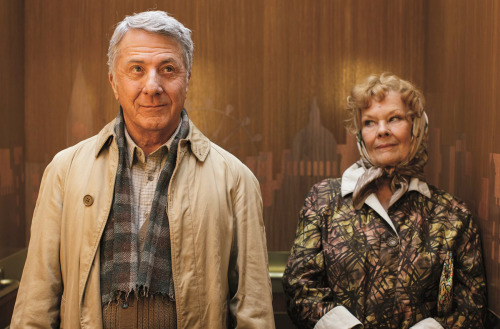
Dustin Hoffman and Judi Dench are Mr. Hoppy and Mrs. Silver respectively in Esio Trot, neighbors dwelling in a high rise somewhere in a bustling British metropolis. And who primarily encounter one another through formal cross-communication via their his and her balconies - Mr. Hoppy above, and Mrs. Silver below. And while Mrs. Silver, an elderly widow, spends most of her time swooning over and babbling to her reptilian object of desire Alfie on the lower level outdoors, Mr. Hoppy, an American bachelor, tends to his immensely overgrown balcony garden above. Meanwhile, the hopelessly smitten Mr. Hoppy embarks on a scheme to fill his house with pet turtles, in a rather convoluted proposed path to the ditzy downstairs neighbor's heart.

And why Mr. Hoppy lives in the UK, or what he's ever done for a living in his spartan existence, remain a mystery. In a rather sketchy conception of a shy, self-effacing and withdrawn, downbeat character - though with weird voyeurism tendencies at times. Mrs. Silver in contrast, is on the flamboyant and kooky side, though equally bereft of any back story. But in the case of Esio Trot, a flaky fantasy seeming in search of an identity of its own too as to whether it wants to appeal to children or adults, none of this hardly seems to matter. Owing to the enormous charisma and charm emanating from this pair of acting legends, no matter what they're up to.


Thursday, November 27, 2014

Big Eyes: The Business Of Art And The Pre-Feminist Stuck-Home Syndrome


Setting the stage for mid-20th century female oppression playing out prior to the women's movement -  as well as in the media  - in Tim Burton's Big Eyes, is Danny Huston's voiceover narrator doing the late San Francisco Examiner columnist Dick Nolan, and subversively cutting to the chase. And all at the same time delivering perhaps the best movie line of the year: "I make things up for a living - I'm a reporter."

Which could not be more to the point, in deciphering through quite metaphorically candid Big Eyes, a financially compulsive US consumer society harboring a dark side just beneath the giddy, deplorable, culturally embedded deceptive commercialism dominating everything. And connected in this case, to domestic violence primarily psychological in nature visited upon the populist artist Margaret Keane. Who was pressured by mid-20th century white middle class limitations placed on women, to essentially collaborate as a component of domestic security and well-being, in her own oppression. And actually, pretty much nothing new, if one considers throughout human history the many women like George Eliot who took male names to have equal access to the privilege of creativity and public recognition. Along with that well known, sadly often repeated rhetorical question historically speaking, why are there no women artists?

Amy Adams projects an alternately subtle and stinging emotional and ethical ambivalence as Margaret Keane, deferring to her arrogant con-man mate Walter Keane (Christoph Waltz), when he assures her that attributing her popular paintings to him instead, is a prudent business move that will substantially enrich their coffers. Which it does.

But this Faustian deception as ambivalent accomplice, driven by her own insecurities as a woman and yearning for a safe haven in a female-demeaning and dismissive world at the time, ironically further entrenches her own invisibility as an artist and human being. And admirably, Burton doesn't simplify the gender based conflict here by opposing a stereotypical female victim with her male victimizer. But rather probes all the self-critical ambiguous issues in between, in crafting a kind of canvas of his own pitting stifled rebellion against embarrassing expediency.

Big Eyes can also claim distinction for probing a less traditionally scrutinized component of domestic violence against women that leaves no physical scars, but destroys countless lives as well - mental and emotional abuse and domination. And perhaps best described in this case, as the Stay-Home Syndrome. And deferring to a husband as dictatorial decision maker, however self-destructive. Though in two instances that might be referred to as sorrowfully sequelized though ultimately triumphant in real life as well, Margaret is seen fleeing two unseemly spouses down the nearest highway - destination scary single motherhood - with her paintings and her child in the back seat in tow.

Then there's possibly Burton's own very personal exploration here, of the business of art. In other words, Walter Keane as symbolic of Hollywood, and the movie industry that aggressively shoves aside any notion of art - when not exploiting and taking credit for it - in the parasitic pursuit of profit. And if this was in fact on Burton's mind as troubling creative subtext, all power to him.


Friday, October 31, 2014

Nightcrawler: Hollywood Hidden Agendas, Hype And Crushing The Competition


Whistleblowing when it comes to media malice, even if fictionalized in movies like Nightcrawler, can't be a bad thing. Even if it's a little like say, treating pneumonia with an aspirin. Or, the police investigating themselves for wrongdoing. Let me explain.

Nightcrawler may have its heart, if not exactly it's calculating head, in the right place as the thriller goes about denouncing television and specifically the evening news for exploiting public fears about crime in racist and class biased terms, in a quest for ratings and profits. And essentially going with stories intended to raise the paranoid panic level in suburbia, about inner city crime crossing the line - literally and figuratively, into their affluent turf.

Not that these sordid manufactured goals are instigated primarily from top down tactics in the film. Rather, it's those from the bottom feeder classes themselves - in similar fashion to the have-nots havoc of those broadcast stories in question - who provide and feed that unethical news cycle in a kind of hypocritical substrata plaguing Nightcrawler. And personified in that particular psychopathic crime scene paparazzi in question, played by Jake Gyllenhaal. Not to mention Hollywood's own looming personal subtextual motives here, in demonizing paparazzi in general.

Gyllenhaal is Lou Bloom in Nightcrawler, a chronically unemployed, alienated young man desperate for work during the ongoing economic downturn, in yet another entry into that growing genre of economic crisis cinema. Stealing and selling scrap metal when not getting into violent mugging, Bloom happens by chance upon a crime scene and the 'vampire shift' free lance LA cameramen who make a living selling those gory photos to television news outlets.

Eventually the deceptively genteel and soft-spoken Bloom ruthlessly eliminates the competition (Bill Paxton), and ends up manipulating and sexually dominating his equally ruthless boss at the station (Rene Russo). And becomes somewhat of a celebrity news gathering predator in his own right, by quite illegally 'creating' his own unsavory crime scenes and scenarios.  

Screenwriter and first time director Dan Gilroy (The Bourne Legacy) has crafted a relentlessly discomforting and disturbing, psychologically dense thriller. But more troubling, is the context. On that note, let's revisit the self-policing metaphor. Are not the big and small screen the very same source of the racist and anti-workingclass fear mongering plaguing ethical values in this country? And in effect, the media assault on the inner city by this fictionalized TV station and  this movie's class based indictment of Bloom, one and the same. And their own offscreen hardly coincidental cultural collusion,  Gilroy and his perp-arazzi protagonist, Gyllenhaal. The latter for his Hollywood rap sheet of not unrelated sordid crime thriller affairs like Zodiac, Prisoners and End Of Watch.    

Then there's the matter of Nightcrawler's dubious division between victims and villains during these economic hard times. Are the bottom feeder designated media monsters in big city underbelly news cycles enriching the coffers of television stations really the impoverished at the other end of the food chain? And in the case of Nightcrawler, even ensnaring their own personal workforce ripe for exploitation? Well, perhaps those feeling most threatened by them think so, or driven by anxieties about ending up there themselves.

And let's not forget that other possible competitive thorn in the side of Hollywood. Namely, the recent small screen surge known as the new golden age of television - a potential challenge both creatively and financially to an industry dubiously turning out movies like Nightcrawler. Along with all sorts of beyond troubling issues in the media not touched upon at all here. Including the one side to every story, brazenly corporate controlled media in collusion with CIA and government entities when it comes to the propaganda relentlessly fed to the public. Guilt by omission? Just some curious food for thought.

Saturday, October 18, 2014

NY Film Festival 2014: Laura Poitras Talks Edward Snowden Doc, CitizenFour


A special, last minute presentation of the just completed CitzenFour documentary directed by Laura Poitras in exile in Germany, was a highlight of the NY Film Festival. Poitras embarks on a real life espionage journey, as she's contacted by Edward Snowden posing as the enigmatic CitizenFour. Which leads her to extraordinary secret rendezvous meetups on the run with Snowden, in Hong Kong and then Moscow.

Following the public screening, Poitras delivered a Directors Dialogue and audience conversation about her not yet released suspense thriller and fugitive from the NSA/CIA escape to freedom documentary. Excerpts from her conversation are below:


More information about the NY Film Festival is online at Filmlinc.com.