Wednesday, April 1, 2015
Revisionist Male Images On Screen: Blaming The Victimizer
Resurrection Of A Bastard
Part Tarantino, part existential live action looney toons, Guido van Driel's adapted graphic novel Resurrection Of A Bastard puts a surreal twist on what might transpire if a mobster were to metaphorically walk in his victim's shows. And in this case specifically, a Netherlands neanderthal homicidally inclined enforcer stricken with a case of soft-hearted human empathy, following an act of attempted murder revenge by the family of one of his victims.
Yorick van Wageningen (the scary rapist in David Fincher's Dragon Tattoo) is Ronnie, the portly psychopathic designated bastard in question. A terrifying thug for hire in the employ of a loan shark for some reason named James Joyce, Ronnie beats to death a young mother who happens by, while he's in the act of creatively torturing a noncompliant debtor by extracting his eyeball with a vacuum cleaner, don't ask.
Following a near death experience when the mother's relative hunts him down and shoots the unrepentant macho miscreant in the neck, he emerges from the hospital as a new and improved Ronnie. And taken to watching snails mate for hours, when not into saving the life of his assailant on one occasion.
Meanwhile, there's a parallel story of young African immigrant Eduardo (Goua Robert Grovogui), who just wants to be a car mechanic with dreams of his own future garage. And doing his best to dodge a less than hospitable xenophobic Europe at the moment. Eventually the two differently alienated men end up in a tree together. Contemplating who knows what, but in any case distancing themselves physically and mystically from whatever pressures come to bear on men, no matter where they're from and how they got there. At least in movies.
The Critic
Move over Scientology. While veiled threats directed at film critics from Scientologist honchos if daring to approvingly review Alex Gibney's damning doc Going Clear, amounted to mere idle cease and desist tongue wagging, Argentine director Hernan Guerschuny's El Critico may be a different matter. Though couched as fiction, this buffoonish bittersweet backlash against film critics who can make or break a movie in a case of the pen being way mightier than a sword, is a none too subtle swipe at those wielding such potentially damaging power. And incredulously as often seemingly whimsical afterthought.
Rafael Spregelburd is Victor, the prominent film critic in question. Beyond jaded and terminally melancholy, Victor feels he is dying, Specifically, suffocating from too many bad movies. Or, as the saying goes among the colleagues of your truly, most movies do nothing but transport you two hours closer to death.
And owing to this dismal state of metaphysical affairs, it's no surprise that Victor trashes most movies in his reviews. Which has to his misfortune, landed him in between a rock and a hard place as a 'taste terrorist.' With his newspaper about to redeploy him to the position just vacated by 'the horoscope girl' because his dismissive assault on movies is costing the publication diminished theater advertising revenue. And on the other hand, a possible emergence of failed filmmaker stalkers with potential malice in mind, owing to Victor's negative reviews costing them their careers. Including several peeved employees at a local theater who, were it not for Victor sealing their fate, would much rather be making movies.
But eventually worse than 'the malady of cinema that is destroying me,' Victor finds himself trapped somewhat in a not too pleasant movie of sorts in the real world. Somewhat held emotional hostage as pathetic protagonist by a mysterious woman (Dolores Fonzi) who has not only grabbed his heart, but the new apartment he wants to rent as well.
Suffice it to say that the mystery female, however flaky, in this case at least triumphs over male belligerence reinforced by the inordinate power inherent in that weird vocation known as film criticism. And at the same time while transformed into an inconsolable lovesick loon, succumbing to the 'cheap emotions' he always reviled in films as a critic up until now. Resulting in, to utter traumatized disbelief, his name mounted all over town on billboard blurb quotes, gushing over a questionable movie.
And whether or not El Critico is satire or a filmmaker's warning to movie reviewers to beware in the future, seems to be up for grabs. Let for a change, you the reader decide.
Prairie Miller
Friday, March 20, 2015
Accidental Love Review: Bandages Instead Of Bombs, Alice Eckle Goes To Washington
A kind of subversive screwball mashup of Hollywood and Occupy Wall Street, the health care crisis satire Accidental Love as co-written by Al Gore daughter Kristin Gore and based on her novel Sammy's Hill, comes off as a different inconvenient truth. When not a deliberate combo of daring and daffy.
Seven years in the making, Accidental Love faced a financial dilemma you could say concurrently rivals anyone seeking actual medical attention in this country. The comic misadventure stars Jessica Biel as Alice, a rollerskating retro-burger drive-in waitress who gets a nail stuck in her head during a construction mishap. And is denied the necessary surgery for lack of health insurance.
But at the same time, even though prone to strange, new uninhibited behavior resulting from the injury, Alice likewise experiences new thinking outside the box. And she's soon off to DC, determined to corner that corrupt contingent of officials there known as politicians. And specifically one tainted but possibly redeemable congressman, played by Jake Gyllenhaal.
And where Alice's push for health care legislation and the operation she needs, is pitted against a bill destined to militarize the moon - being pushed through in a convoluted ploy involving devious Capitol Hill conspirators counting Catherine Keener, James Brolin and Pee-Wee Herman, don't ask. Tracy Morgan also turns up in an unfortunate coincidence, as Alice's friend with his own set of bad health issues.
Accidental Love has its heart in the right place, but does itself somewhat of a disservice by not trusting its audience that has been fed an infantile, unrelenting diet of Hollywood - along with the tabloid tendencies of the capitalist media, to care about serious issues up on the screen. Kind of like feeding the masses fried chicken - but hold the organic veggies for last.
The movie seems to be part of confrontational but flawed fluff in an emerging new genre that could be termed too close for comfort controversy cinema. Created by mainstream filmmakers and actors who just want to care about the world, and that recently counts The Cobbler and The Gunman as well. But whatever the shortcomings, their decent sentiments ultimately rule. And Accidental Love gets a pass for sheer outrage. Or as Reverend Norm (Kurt Fuller) declares so tellingly in the flaky finale, 'it's messy - as life often is.'
Prairie Miller
Thursday, March 19, 2015
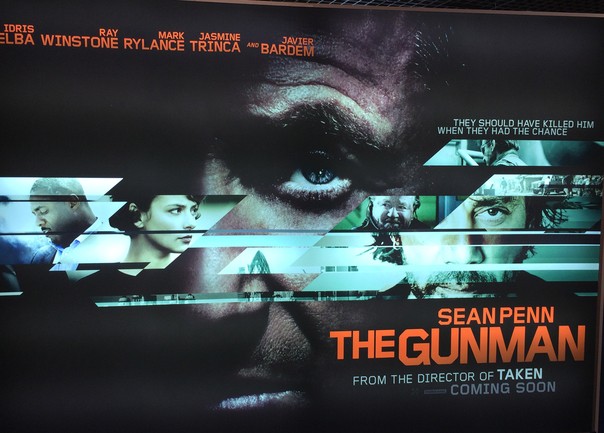
Anti-American Sniper: The Gunman Movie Review
The Gunman: Terrier Saved By The Bull
Money and morals are definitely a difficult if impossible combination to pull off. And this contradiction could not be more true than in the impulse lately of mainstream filmmakers and actors to make meaningful movies with an indie heart, while keeping a foot firmly in Hollywood.
That is, when it comes to what formulas that flourish at the box office, namely action thrillers and crude comedy. Which seems to be lately heralding in a peculiar new emerging, unfortunate juxtaposed genre, that aims to sell pressing political issues to the public by sugarcoating them with fluff ranging from mindless to inane.
And in that sense, such films may reveal more about mistrust of the masses to comprehend their own basic human needs and what's ailing America. And that condescension likewise extends to film critics in a different sort of way. Namely, an even more entrenched class bias that not only expresses contempt for the masses, but critical blinders as well in understanding the world only on their own primarily middle aged, white, and comfortable middle class terms.
Which brings up three recent politically driven releases, all resoundingly denounced - surprise, surprise - by critics: The Cobbler [urban removal themed] and Accidental Love [the health care crisis]. Both are crafted with sincere conviction, no matter how muddled with goofy comedy. But the third, The Gunman, directed by Pierre Morel [Taken] fails on all counts.
A kind of Anti-American Sniper - though this is in no way a sequel - Sean Penn stars as Terrier, a double dipping, ultimately remorseful mercenary staked out in the Congo. Presumably assisting an NGO with public works development, he's likewise doing the bidding of Western mineral interests. And in that capacity, Terrier assassinates a government minister in the way of a multinational's theft of natural resources there. And any of this seemingly a pretext for lots of gunplay - indicated without subtlety by the title - the relentlessly bulletproof Penn, a climactic showdown at a bullfighting ring and bodies littered across numerous international locales.
To sum up, in the midst of multiple mercenaries, matadors, a two-timing damsel in distress, corporate conmen and standard macho mayhem with a differently duplicitous Javier Bardem checking in as well, dishonor among thieves abounds. Not to mention that NGOs - without any significant research kicking in that might have uncovered them as more often than not, notoriously in bed with the multinationals everywhere themselves. And in just as many cases, more effective as shrewd propaganda tools, than the blatant activity of mercenaries.
In any case oddly enough and back to those matadors in question, the aggravated anti-hero is saved by the bull.
Prairie Miller
Friday, February 20, 2015
Effie Gray Movie Review: Fifty Shades Of 'Gray' ? Male Sexual Cruelty On Screen
While there may be a never ending procession of movies in theaters about artists throughout history having to suffer for their art, rarely are there sightings of the women in their lives made to suffer too. Often at the hands of highly creative but beastly mates, when it comes to the treatment of their female significant others.
Not that this reality is in any way a relic of the past. Men who are artistically inclined seem to be given a pass when it comes to the treatment of females. And most notably today in the ho hum attitude towards dubious distinguished dabblers in the arts like Woody Allen and Roman Polanski.
Of course the opposing argument can be made that art should be separated from personality, however repulsive - or the dastardly deeds of its creators. But an ironic spotlight on the women they've abused historically while being showered with nonjudgmental accolades, might be welcome for a change as well, in movies.
And such could not be more the case than the splendid, lyrically and gracefully crafted and visually sumptuous as art in its own right, period biopic Effie Gray. Written by, co-starring and conceived with uncommon female sensibility by esteemed actress Emma Thompson, Effie Gray exquisitely places front and center this Victorian era woman (played by Dakota Fanning) who endured in emotionally imprisoned, sexless slave marital bondage, a union with the eminently talented but odious John Ruskin. In other words, a different Dakota's Fifty Shades Of 'Gray'?
Ruskin, played with supremely insufferable disdain by Greg Wise, was the leading 19th century English art critic and a prominent painter. He married Euphemia 'Effie' Gray, a provincial young Scottish woman and the child of a family friend residing in a former Ruskin residence. And oddly or rather perversely enough, herself born in the very room where Ruskin's grandfather committed suicide.
But Effie's giddy romantic notions soon turn to perpetual gloom, when Ruskin is filled with disgust on their wedding night by her exposed female body for the first time. Heartbroken but imprisoned in a marriage she cannot escape without scandal - not to mention that the union had been irrevocably sealed economically by her debt ridden family because Ruskin agreed to support them financially, which would then be terminated by divorce - Effie hopelessly suffers through this unconsummated marriage for half a dozen years. Which is further exacerbated by Ruskin's overbearing, contemptuous mother, played with elegant cruelty by Julie Walters.
But Effie finally gathers the courage to defy the oppressive dire circumstances of the day faced by Victorian women, through her friendship and support from a fiercely liberated confidante, Lady Eastlake (Emma Thompson). All of which lends a novel historical notion to those many idealistically conceived visions of women in paintings back then, including Effie who herself often served as a model - that they were not only frozen in those frames, but locked up in their own lives as well. Or as becomes evident in the course of this visually resonant film in its own right and in Ruskin's own words, that rather than a beloved human mate 'consider me the luckiest of mortals, granted a muse.'
And though there could have been more deciphering and depth to Ruskin's character rather than bordering on a stick figure emotional villain - in contrast to Effie's vividly fleshed out portrait - some mysterious intimations linger throughout that he may have been a homosexual resentfully locked in a Victorian closet himself. Though the record beyond this film may speak otherwise, and suggest pedophilia instead. With some evidence that Ruskin first became infatuated with Effie when she was around eleven years old - and he in fact wrote a fantasy novel for her at the time, The King Of The Golden River.
And years after their divorce (whose records indicated physical disgust for her, and possibly upon the sight of her pubic hair) at the age of 39, Ruskin became smitten with another child, ten year old Rose La Touche. And when her family refused his request to marry her eventually, Ruskin suffered a series of mental breakdowns. Subsequently stricken with hallucinations after Rose's untimely death, which he obsessively experienced as conversations with the deceased object of desire.
And quite interestingly as a side issue to the film, is that the Ruskin scandalous divorce proceedings are said to have contributed to the now well entrenched perception of suppressed Victorian sexuality that precipitated the entire subsequent Freudian cottage industry direction of psychiatry. Yet a possibly wrongheaded perception, that could have been pedophilia suppression instead.
And in keeping with Thompson's breathlessly captured moments, however fleeting in some cases, is Effie's exchange with the Ruskin household butler George (Russell Tovey) before she effects her elaborate escape forever from her emotional incarceration there. Recognizing her secretive flight, he confides that his name is not really George, but rather John. And that Ruskin made him call himself George instead, because his imperious employer would not tolerate another John on the premises.
And the now defiant and enlightened Effie when George says he didn't mind, declares in a luminous moment of shared class and gender awakened solidarity, 'You should have minded - he took away your name.' As Ruskin did in marriage, taking away as with George, not only her name but her humanity.
And as an upbeat footnote beyond the solemn proceedings of the film, Effie Gray after fleeing her suffocating circumstances, eventually married Ruskin protege painter John Everett Millais. Who was not horrified by her body, and with whom she eventually bore eight children.
Emma Thompson, you rock.
Tuesday, February 17, 2015
Gemma Bovery Review: A Feminized Flaubert And Objectified Male In The Buff
A sort of satirically laced literary pseudo-biopic, French writer/director Anne Fontaine's Gemma Bovery may very well be posing the question, what if Madame Bovary had been written from a woman's point of view instead. Though this somewhat lunatic provincial romp playing out in the present seems to have more to do with an idealized sense of existence lived within the unbridled male imagination that literary obsession might lead to, as opposed to being anchored in the real world.
In a tall tale romance with possibly no less than four infatuated males crowded into a single love triangle, Fabrice Luchini is Joubert, a despondent countryside baker in a region where wine is apparently deemed the local anti-depressant. Having bolted from Paris with his wife and son to rustic Normandy after ditching a vocation for a publishing house annotating university papers 'that nobody will ever read,' Joubert doesn't exactly discover a sought after serenity in taking over his father's town bakery.
On the other hand, his new relationship making bread and exploring a novel sensuous connection between flour and flesh, and exacerbated by his hopeless fixation on Madame Bovary, bodes ill when a new and fetching British neighbor (Gemma Arterton) turns up with the uncanny name Gemma Bovery. Not to mention Flaubert having written the novel right there in the 19th century.
Which eventually evolves into the silently smitten Joubert leading an alternate double life between baker and lurker. And stalking his often imaginary object of literary desire, while eluding her clueless artisan spouse (Jason Flemyng) and a seductive law school matriculated boy toy (Niels Schneider) holed up in a local castle. And ultimately in a sense, an intertwining of this fanciful fable with the radically revised novel running all around inside this Flaubert impersonator's borderline hallucinatory head.
This is Arterton's second venture into graphic novel screen stardom, following Stephen Frears' Tamara Drewe in 2010, and with Gemme Bovery adapted from the likewise female perspective penned by Posy Simmonds in both works. And the concoction however pensive, is a delightful blend of magic and buffoonery. Not to mention a film finally where in sex scenes the woman gets to keep some clothes on, while the male is consigned to prancing around in the objectified buff.
Prairie Miller
Monday, February 16, 2015
The Lesson Review: Bulgaria/Greece Dramatic Co-Production A Class Act On Toxic Neo-Colonialism
Economic crisis cinema in these unrelenting hard times, even when simply subtextual to larger themes, has mushroomed as we've observed, into somewhat of a genre in its own right in this country. But European cinema may be catching up these days with their own end stage capitalism mass misery. And the Bulgarian combo domestic drama/moral thriller The Lesson [Urok] as revelation raises those bitter stakes with its post-Soviet, been there done that reverse requiem of despair under the domination of the dollar, kicking in as well.
And with much more than just classroom lessons to be learned, or maybe not, in the solemn and disturbing The Lesson. And like many other post-USSR films preceding this one edging back down memory lane, and possibly playing out as a kind of second thoughts cinema evolving across Eastern Europe ever since then.
That is, seemingly spontaneously precipitated as sobering reflection since the overthrow of the Soviet Union twenty-five years ago - and Eastern Europe turned into a vast, occupied US/Nato military parking lot. And that The Lesson is a Bulgarian co-production with a Greece currently in mass uprising, may in a more immediate economic and sociopolitical hindsight sense, be no mere coincidence.
Nade [Margita Gosheva] is a middle class mother and teacher of preteens, and reluctant family breadwinner married to a slacker spouse. Silently resigned to her fate and struggling to make ends meet translating documents into English for a company that keeps making excuses not to pay her, Nade is likewise an English language teacher - and in a telling narrative thread under the increasing Americanization under the basically unannounced occupation of that country.
While concurrent US values seem to have seeped into the culture as well, epitomized in the new predatory money lust and ruthless greed under the establishment of capitalism. And epitomized in a classroom incident that infuriates the normally passive Nade, when one student steal another's wallet and refuses to confess. Nor does anyone in the class seem to care, or offer witness testimony.
And as a woman who appears to still be imbued with the ethical sense of collective unity under socialism, a frustrated Nade insists that everyone among these indifferent students contribute a portion of their own money to the victim, to compensate for what was stolen. But even this mandatory gesture fails to comfort the teacher, who remains distraught and fixated on this troubling lack of humanity evidently afflicting the next generation.
But Nade is soon caught up in her own personal victimhood, when threatened with eviction and the auctioning of her home within a day for lack of payments to the bank in question. Thus begins a terrifying race against the clock alternately sorrowful and suspenseful quest. And at one point leading Nade in desperation to beg strangers on the street for money, and then reluctantly rolling up her sleeves and scooping coins out of a park fountain so she might run to the bank and avert the eviction within minutes of closing time. Though her troubles are apparently just beginning, as Nade herself is dragged down the rabbit hole of debasement and demoralization.
The Lesson is as potent and gripping in its own way, as the iconic, trailblazing race against the clock 1950 noir D.O.A., as visited upon Edmond O'Brien's Frank Bigelow. But while D.O.A. involved an actual toxin that is frantically confronted, this bleak film's poison is more metaphorical as a component of perplexing survival, though no less penetrating and potentially irreversible - capitalism and socioeconomic corruption of the soul, despite one's best intentions.
Wednesday, February 4, 2015
The Sundance 2015 Wrap-Up Report: Taking On Scientology At Sundance
**Going Clear At Sundance: The Real Deal On What's Going Down Behind Scientology's Secretive Doors. In his Sundance 2015 Wrap-Up Report, Indiewire chief critic Eric Kohn phones in to Arts Express on location in Utah at the Film Festival. With a look at the most controversial entry there, Alex Gibney's Going Clear: Scientology And The Prison Of Belief. And how the Scientology cult has been intimidating film critics including Kohn, who dare to report on the documentary's exposure of member manipulation, physical abuse, and torture connected to a space deep within their fortresses - notoriously known as The Hole. While HBO has lawyered up with 160 attorneys in anticipation of doing legal battle with Scientology when they air the film. And, other Festival highlights ranging from white supremacy to the Black Lives Matter movement; the influence of Hollywood at Sundance when it comes to creative impulses versus creative control; and what audiences can look forward to - or shouldn't - from these Festival debuts during the coming year at the movies.
Listen To The Show Here
**The Devil's Violinist: Musician and solo performer David Garrett is on the line from LA to talk about his role as 19th century daring innovative rebel musician Niccolo Paganini in this biopic. A celebrity violinist himself, Garrett discusses becoming Paganini in every sense, emotionally and musically; marrying in his own crossover compositions classical and contemporary music; and who exactly is that violinist's devil and does he exist as well today.
**The Working Actor Studio: Jack Shalom in a conversation with Working Actor Studio director, Betsy Daly, about meeting the economic and artistic challenges facing struggling, aspiring actors today. And developing the necessary dramatic skills and tools there, including workshops in improv, scene study and musical theater. And, something rather intriguing known as stage combat.
Arts Express, airing on WBAI Radio in NY archived at wbai.org, and on the Pacifica National Radio Network.
Subscribe to:
Posts (Atom)